Rally is not always about the Q’s

The reason I fell in love with rally, and became a judge, is because rally is about having fun and working together with your dog. Teams of all ages and abilities are welcome to participate and corrections in any form are heavily penalized. I also love CARO rally in particular because the trial environments I have encountered have been more relaxed, more encouraging and less stressful than other venues I have competed in.

I have been judging since 2010 and have had the opportunity to watch some really great teams at work, however, because rally obedience is a sport complete with rules, point deductions, passing and failing, some of these teams have not qualified and more often than not, it breaks my heart.

Sometimes great runs are non qualifying because a team completely misses a station.

Sometimes the dog does exactly what he or she was asked to do but the handler asks for the wrong behavior.

Sometimes a dog is incredibly unfocused to start but is able to refocus and finish the course.

Sometimes a dog is struggling with his or her own fears and anxiety and the handler just decides to stop competing, take out a toy or cookie, and make sure their dog has a good time.

Sometimes a handler is working very hard to keep a dog “in the game” but for whatever reason, the dog just can’t do it.

During my judges briefings, I always try to tell competitors that it is unlikely that anything that happens in the ring will surprise me because Bear and I have not qualified many, many times for many, many reasons. I share this because I want them to know that I am aware of the time, effort and training that goes into preparing a dog for trials, how much courage it takes to perform in front of an audience and how much composure it takes to be happy and positive with your dog no matter what happens in the ring. I also share this because I want competitors to know that I have been where they are and I understand all of the stress, anxiety and emotions that crop up when things do not go as we had hoped.  But more than anything I share this because I want competitors, especially new ones, to understand that not qualifying does not mean that you have a bad dog or that you are a bad trainer, it just means that you had a bad run. The best thing to do about it is to learn what you can from the experience and use that knowledge to improve on the next run.

Unfortunately, aside from my judges briefings, time to seek people out to give them a quiet word of encouragement is limited and time to draw attention to great non-qualifying work is almost non-existent because it is a trial, not a class or a seminar: there are scorecards and ribbons to hand out, courses to set, questions to answer and trial records to sign.

After thinking about all of this for some time, I decided to start recognizing great work (qualifying or not) at a time when everyone is gathered and attentive – when it is time to hand out ribbons and scorecards. I give scorecards and ribbons to qualifiers and then, while everyone is present, I highlight the great work being done by dogs and their owners by giving out Judge’s Choice Awards. These awards are given to teams that I think exemplify team work, enthusiasm, or great work ethic, regardless of their score. I have also given them to teams and individuals that have made a drastic improvement throughout the trial or to handlers who remind me through their actions that rally is all about having fun with our dogs.

Ayoka Bubar, CPDT-KA's avatarPrairie Dog Daycare

Below you will find the complete results for the CARO trial held last Sunday at Prairie Dog Daycare and Two Brown Dogs. Our next trial will take place June 16-17, 2012 and you can find the premium list and entry form here!

New Titles

Andy & Atom – Rally Novice

Awards

High Scoring Visitor – Patricia & Snippy (190)

High Scoring Senior Dog – Tom & Isis (190)

High Scoring Rescue – Shelley & Max (174)

High Scoring Two Brown Dogs Student – Michelle & Dexter (189)

Judges’ Choice Awards – Susan & Daisy, Kimberly & Bishop, Angela & Zoe, Shelley & Max

Full Results


Novice 1-ANovice 2-A
1. Michelle & Dexter (187)1. Michelle & Dexter (189)
2. Darrell & Lexi (185)
3. Diane & Piper (182)
Novice 1-BNovice 2-B
1. Patricia & Snippy (190)1. Patsy & Zoe (189)
2. Patricia & Snippy (182)

View original post 68 more words

Our First Herding Adventure!

Yesterday, Bear and I went to 4U Farms in St. Norbert to take part in a Herding Instinct Test. Herding has always been something I’ve been interested in trying with Bear but until now, there has always been something to prevent us from doing it.

As some of you may know, Bear is a rescue and has been approved for a CKC Performance Event Number(PEN). This means that even though we do not know anything of his parentage, he looks enough like a Rottweiler to participate in Canadian Kennel Club Sanctioned performance events including herding trials. Believe it or not, Rottweilers and their ancestors have been herding for centuries, therefore, it is to be expected that today’s dogs will exhibit some of that genetic tendency so I thought I would like to see if Bear could herd.

Herding Behavior

Herding is, essentially, predatory behavior and according to Clarissa Von Reinhardt, in her book, Chase! Managing your dog’s predatory instincts, a full predatory sequence includes:

  1. Finding the prey
  2. Orientation posture
  3. Sighting the prey
  4. Stalking/encircling
  5. Chasing/driving
  6. Attacking (grabbing)
  7. Killing
  8. Dissecting
  9. Consuming and/or carrying away and burying (storing).

Through selective breeding many herding, guarding and hunting breeds have had certain aspects of this behavior enhanced and certain aspects eliminated altogether. A retriever performs the entire chain up to #6 and retrieves the bird to his human. A guarding breed may perform the full sequence depending on the the species of the intruder into his territory. Herding breeds mostly perform the sequence in various ways up to and sometimes including #6 depending on the dog and, I imagine, the livestock.

The Test

The Herding Instinct Test was explained to us by the evaluator, Roy Sage, as a way to evaluate a dog’s desire to herd and his herding style. For some people this knowledge is a way to confirm their dog behaves as a dog of his or her breed should and, for others, this knowledge will form the basis of a training plan if the dog and handler plan on continuing to work in herding.

The test began with us walking into the pen with Bear on leash. Roy Gave me the Brief History of Rottweilers and explained some of the things one might see in the breed while herding. He also made a point of petting Bear, giving him some good scritches and talking to him before we got started. He did this with every dog that went into the ring and it was interesting to watch. I thought of my own behavior with dogs in class and/or how I have seen other trainers interact with my dog and I can’t say I (or anyone else) interacts with dogs they are training that way. Part of the reason I do not, generally, is because I want the dogs focused on their human and not me. I wonder if it’s important for him to create a rapport with the dogs since he is doing most of the handling or if it is just something he does. I wish I could drive back to St. Norbert and ask him. If I meet him again, I will be sure to ask!

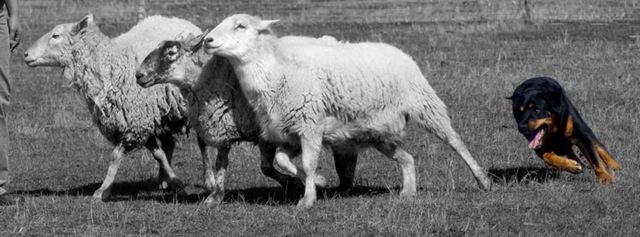
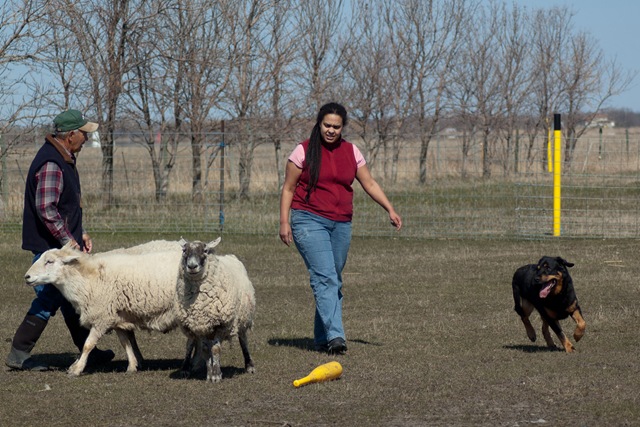
After a bit of Bear trying to chase the sheep on leash, I was asked to drop the leash. I was terrified. Bear has gotten into it with a dog or two – what if he hurt a sheep? Would I be able to pull him off a sheep? Would the presence of sheep shove him so far over the top he couldn’t listen. Knowing nothing about herding, I did as I was asked and Bear took off after the sheep like a rocket. Surprisingly enough he didn’t move in to bite or grab but circled around as they moved towards the evaluator. What was remarkable to me was that his body language was alert and excited but not crazed, stiff or out of control like he is before he thinks about starting something with another dog so I was able to relax and enjoy myself!

Bear3
Bear showing a wonderfully relaxed face and body, but you can tell he's still on the job!

It felt like we spent an hour in the pen but, according to my video camera, it was more like 10 minutes including our chat at the beginning. During the 6 minutes Bear actively worked the sheep, the evaluator explained some of the things he was seeing in Bear and what he (the evaluator) was dong in response.

The first thing he noticed was that Bear did NOT like the bat they use to create pressure and move dogs off sheep. Bear’s response to the bat was to stop, back off and go sniff. In the video below, you will see the evaluator  drop the bat and use his arm to encourage Bear to change direction instead.

The second thing he mentioned was that Bear liked to work really close to the sheep – he even tried to get in a few nips. The evaluator though that this might be something we see more of as Bear becomes more and more accustomed to the sheep and the herding game.

Toward the end of the video you will see Bear get a correction with the bat for diving in to nip sheep. His reaction was (again) to back off and if her were human, I would say he was sulking. Personally, I think he was confused – we were letting him chase the sheep but not exactly the way he wanted to.  Anyone who knows me knows I am not someone who likes this kind of physical correction. After seeing his reaction, the evaluator said that Bear was a ‘soft’ dog that does not need such a hard correction. That much, I already knew. In no way was Bear physically harmed (the bats are hollow and plastic) and you can see he recovered and did one more ‘go around’ but it is not the way I want communicate with my dog. If we continue, I am going to ask the trainer about how to avoid that scenario (diving in on sheep) altogether I have a feeling that as I learn more, I’ll be able to keep him off with a little pressure.

The second most surprising thing to me (aside from not eating sheep) was that at the end of the session you will  see Bear do two downs with the sheep moving. I can’t imagine a much more distracting environment and he was able to use his brain (after I asked a couple of times – there may be hope for him yet!

Bear8
A nice down while the sheep look on.

After our turn in the pen, we received a Herding Instinct Test Certificate and a very interesting evaluation form which was completed by the evaluator. There was way more to evaluate than I would have thought possible and the following website explains each section along with how and why a dog may fall into a certain category.

This experience was, without a doubt, one of the best things I have done with Bear. It was enlightening to see him doing something so naturally. When you spend as much time training for various things as I do, sometimes it is easy to lose track of the really amazing things our dogs can do. I am a little saddened by how long it took me to do this for Bear. The positive part, however is that I have a better sense of just how hard things like rally, obedience and agility are for dogs that have been bred (more or less) for centuries to chase, hunt and herd.

HerdingBW
My favourite photo of the weekend!

Previous Post

Ayoka Bubar, CPDT-KA's avatarPrairie Dog Daycare

Brandon-20120214-00116

At Prairie Dog Daycare we have a number of policies in place to help ensure your dog’s safety but did you know we’re Pet First Aid Qualified? This includes myself and any helpers I might leave your dog(s) with should I need to step out for an hour or two.

Pet First Aid is essential for anyone working with multiple dogs in an off leash setting where knowing how to assess injuries and when to seek veterinary care can mean the difference between life and death for your pet. In my opinion, ‘hoping’ nothing happens and telling my clients that “dogs never get hurt here” is just plain wrong! The potential injuries in a dog daycare range from torn nails to bites and everything in between and I feel that I owe it to my clients (both ethically and legally) to be prepared for every possibility.

A couple of months…

View original post 736 more words

At Last…

Bear and I were  in Regina last weekend for the KAOS DogSports Rally Obedience trial.

We have been chasing our Versatility title since 2009 and KAOS was offering two versatility runs on the Saturday. In the interest of saving money, I decided to drive down Friday evening and home on Saturday evening which meant only 1 night in hotel and the cost of 4 runs as opposed to 2 nights hotel and the cost of 7 runs.

In true nervous fashion I was up at 6:50am the morning of the trial and forced myself to lounged in the hotel until 10am after housekeeping knocked on our door for the third time. Even then, we had quite a few hours of waiting before our runs.

Our first run was an Excellent C run. Bear got sucked in by the food bowls, then I made a ton of mistakes. In the C stream there is no room for mistakes we needed  a score of 190 to qualify and even if we did not retry anything we would have been well over 10 points worth of deductions.

Our second run was in Excellent Team and we managed to get a video of our half of the run below.

Bear had a fantastic run but our team partner did not we didn’t earn a qualifying leg. Team is a challenging class and we have been the cause of a lost Q in a team run too so I was not overly worried or disappointed. What mattered was that Bear had a better run which made me very optimistic that our versatility runs would go well.

Our first Versatility course was tough, lots of angles which were confusing and required more of my attention than Bear could tolerate. We had quite a few deductions for Bear being out of position and my subsequent extra cues. We then had a muck up at the off side weave poles which earned us an NQ for improperly performing the station. I was really disappointed because I really wanted that Q and of course the next course contained the tunnel which is always a challenge for us. I was certain we were doomed to go home without our title.

During the walkthrough for the final Versatility class, I hatched a plan for avoiding the tunnel because working around it would be our biggest challenge. I used the entire walkthrough. During our run Bear did drift a couple of times however he only paid attention to the tunnel when he was supposed to and we managed to qualify with a score of 186 – WE DID IT!!!!!!

CRVweb

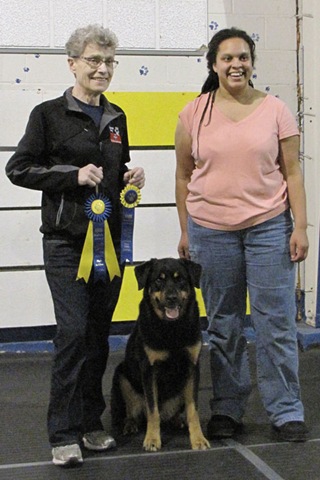
It took us almost 3 years and 9 tries (and I don’t want to think about the entry fees, hotel and gas costs) but we did it with an average score of 187 – enough to earn the Cum Laude designation!

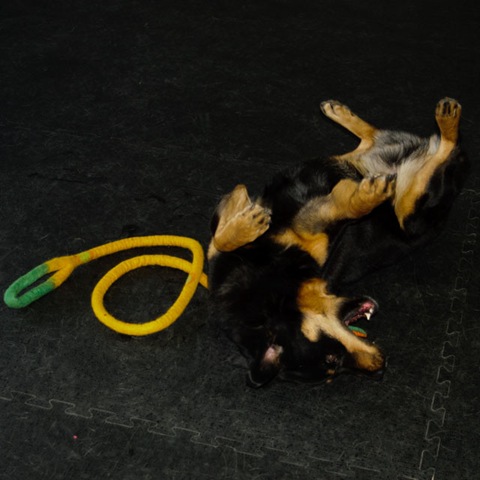
For all the hard work, I bought Bear a fabulous tug toy, made of boiled wool.

roll-tugweb

It’s about 6 feet long, which is long enough to keep his teeth far, far away from my hands, it’s very strong and it’s made of texture that he loves. Best of all, I purchased it online through http://dogztore.ca/ and was able to pick it up at the trial and avoid paying shipping fees!

I just wrote the following post over at the Prairie Dog Blog about a recent webinar I attended on Preventing Poisoned Pets.

Ayoka Bubar, CPDT-KA's avatarPrairie Dog Daycare

image I recently attended a webinar called Preventing Poisoned Pets delivered by Tina Wismer of the ASPCA Animal Poison Control Centre.

Given my pet first aid training, I thought I knew what I needed to know about pets and poisoning. However,  this seminar was offered for free and counts towards the 36 hours of continuing education credits I need to recertify as a Certified Pet Dog Trainer in 2015, so I decided to take it – and I’m really glad I did.

I learned a lot of new things that I bet you didn’t know either so I’ll list the ones that really surprised me.

  • Did you know that  one 200mg Aleve (Naproxen) tablet can cause kidney failure in a 40lb dog?
  • Did you know that aside from causing liver failure, acetaminophen (Tylenol) can cause face and paw swelling in dogs which might be mistaken for an allergic reaction?
  • Did you…

View original post 385 more words

A Case for Keeping Rally-O Records

Not long after the KAOS Trial back in November, my CARO Advanced Team Certificate arrived! I was so thrilled because it’s our first CARO title in 2 years!

As I admired the certificate, something didn’t seem quite right. Finally I realized that under the “Registered Name” portion of the certificate it read B.A. Bearacus, RAMCL, RNT…this couldn’t be right – we earned our final Excellent leg and Excellent Title in June of 2009 under judge Renee Will and I had the certificate on the wall to prove it. So assuming maybe it was a simple typing error, I emailed the person responsible for printing title certificates to let her know of the error and her reply to me was that according to CARO records, we earned 3 Excellent legs under one judge and would need another leg under a second judge to earn the title. She did state that there could be an error with the CARO records and the best way to rectify things would be to find and submit my score sheet for the leg that was incorrectly recorded.

image

This is where I started to panic…I have a title spread sheet in Excel for pete’s sake! How could I have overlooked that detail? Maybe the stress of owning a business really ISgetting to me and I’m losing my mind!

To put my mind at ease, I immediately went to check my rally book, where I keep my CARO handbooks, my judge’s trial records, past courses and, our past scorecards and qualifying ribbons. After a bit of rifling, I discovered that I only had score sheets for the latest titles – not to worry though, I knew where the rest were at home – at least I knew what room they should be in. Once I arrived home, it became painfully clear that I really am a pack rat but that keeping everything and keeping everything in one placeare two completely different things.

Every judge and trial secretary must keep their trial records for at least one year. It was well beyond a year but I still contacted the judge who we earned our last leg under and she still had the trial records. I was able to scan the trial record and sent it to CARO to have the leg and the title credited in the database and a new certificate was issued.

Now I have all my score sheets and title certificates arranged in their own binder in chronological order with the latest score cards first and you better believe I’ll be keeping track of every qualifying scorecard from now on!

The lesson to you all is to:

1. Always keep your qualifying score sheets in a safe place (A binder works and so does scanning them all and saving them electronically)

2. When it comes to Team runs, if one partner takes the scorecard the other should photograph it for their records – sometimes you know your partner, sometimes you don’t.

3. If you are a CARO member, keep an eye on your dog’s ID page after every trial so that you can catch any errors as soon as they crop up.

Regina – RKOC CARO Trial

what success really looks like

As a follow up to my previous post, here are the details of our most recent weekend in Regina.

Friday evening we stopped by the club so I could get my bearings and so that I could let Bear figure the building out and get some of his silliness out of his system. My plan for my few minutes of floor time was to do as much of the course as possible but to take in both cookies and my clicker for some rapid reinforcement if necessary. I did not spend a lot of time walking the course but ran through quickly twice and then took him out of the car to stretch his legs. Our run through was ok – Bear was a little distracted by a mat leading to the potty yard (which club members admitted was likely saturated with urine) and then I entered the cones for the Weave Once exercise improperly but otherwise Bear did not seem overly distracted, he didn’t do an excessive amount of scratching, sniffing, wandering or visiting and he was really really interested in the tuna treats I made a few weeks ago.

This was our first time at the Regina Kennel and Obedience Club, and I really like the space . The ring is completely separated from spectators and the crating area. The only people in the ring are the handler, the judge, the timer and the table steward(s). This is ideal for us and, I suspect, for other distractible dogs.

On Saturday we were entered in three runs: Two Excellent C runs and one Versatility run. All of our runs were in the afternoon so I spent the morning helping lay courses while Bear chillaxed in his crate in the car. Crating in the car seems to be the must successful option for us as it keeps Bear in a familiar place away from the comings and goings in any crating area.

For our first Excellent C run, I brought Bear out one dog ahead of our turn, we did some simple exercises for cookies and then headed into the ring. I took off his collar, popped a few cookies into his mouth and without wasting any time we were on our way! Bear worked really well, getting slightly distracted at a few stations which lost us a total of 5 points and, he forgot how to sit at one station and stood there staring at me with a ridiculous grin on his face. I needed to ask him to sit again which lost us another 2 points. In  total we lost 7 points and earned a score of 193 (out of 200) which was high enough to earn our second C stream leg. This was the harder of the two courses for us with the black hole Tunnel and the Halt – Recall while running (Bear has to stay while I run away) so I was really, really pleased with his work.

The Second Excellent C course was also difficult with both the backup 3 steps and the spread jump. Bear had a bit of a stress scratch before our run and when he was done, I popped a bunch of cookies into his mouth in rapid succession and then we were off. Our backup was satisfactory (we got a checkmark) however Bear completely missed the spread jump, I sent him again and he took it although he was perilously close to the edge – I’m not sure I would have passed out second performance if I was judging it. Since we already disqualified by this time, for the remainder of the course, I chose to use the cookies in my pocket to reinforce any work that I thought was nice. I felt this was a great opportunity to teach him that sometimes a dog CAN get cookies in the ring, especially if he is paying attention. The judge was kind enough to continue scoring us and we did lose a few points for double commands and the few times Bear forged ahead. Had Bear taken the broad jump, we would only have lost 8 points and our run would have been another  qualifying Excellent C leg. I was really happy with Bear’s attention through this course and his nice back-up work. I knew the spread jump would be problematic because we haven’t been working on it much.

Our third and final course was the Versatility course. We have been chasing this title since 2009 and only need ONE more leg to earn it. we started of really nicely – Bear had only eyes for me. he lost position slightly during a right hand heeling spiral and then forgot to stay during the halt-sit-walk around. I decided to give him the sit stay cure during the walk around in hopes that I would only receive deductions for him being out of position and for my extra commands.  aside from this, the rest of the run was nice – only a second command to get bear to come in front at the second to last station. After the run I was pondering why Bear got up during the walk around – he never does this – EVER and then I started wondering whether I told him to wait or not. We ended up disqualifying on that exercise (which I believe was reasonable) and when I asked a few others if I had given him the wait or stay cue, they said I did not. Full responsibility is on me, therefore for not qualifying during out Versatility run. That being said, it was a beautiful run and we would have completed it with a score of 195 had I been more on the ball.

This certainly underscores the need for precision handling and a few people mentioned this is why they taught a sit as a “sit until you are asked to move” thus removing the need for the extra stay cue.  I can see why that’s a great idea however the corollary of sit meaning “sit & stay” is that you then need to cue your dog every time you want him to move forward in heel position. While I’m judging I certainly have deducted a good deal of points for dogs that did not maintain position during the ‘walk around’ exercises but I have also deducted a good bunch of points for tight leashes when people forget to cue their dogs to move forward and the dog remains sitting until he or she is essentially dragged forward.

Both meanings of “sit” are valid, in my opinion,  as long as communication remains consistent. However, I’m not about to change our training vocabulary because: 1.) Bear is 7 and it seems like we are FINALLY beginning to speak the same language; and 2.) I would prefer his default behavior to be staying with me and maintaining eye contact since he does have a tendency to wander around.

Our total practice time for this trial (since last week) was 27 minutes and I do think it helped with the back up. I also think there’s a lot of value in spending equal time plying with your dog as training. For us, the trick with Micro Training now, is to incorporate more than one set of sessions into the day to work on other behaviors like the broad jump and spirals while right side heeling.

When it was all said and done, I was thrilled with Bear and also my ability to keep my nerves in check – actually I think I totally forgot to be nervous – maybe because  I had rather low expectations given our lack of practice. Either way, I’m rather confident now that we’ll be able to achieve our title sometime this spring or summer, depending on when we can get to another trial.

A Surprise and an Opportunity to put MicroTraining to the test

image

I love how life occasionally presents unexpected opportunities.

I had pretty much resigned myself to a rally trial free winter when I got an email from one of the folks with Regina Kennel & Obedience Club. One of the judges they had lined up is ill and not able to judge this weekend – would I be able to fill in last minute for her on Sunday? As a trial secretary, one’s worst nightmare is a judge that’s unable (for any reason) to keep the assignment and here on the prairies, weather and travel can be very real obstacles so can a sick or injured judge.

A quick call to Sean to confirm he’d be ok stranded at home for the weekend without a car and I replied that I would….OF COURSE!

This means I’ll be able to attend the trial Saturday with Bear and – oh crap – I have not been working at all on those things we aren’t so good at back in November like the back up 3 steps, the food bowls and the moving sidestep right. So I figured, what better time to put our minute by minute micro training to the test. Since I can’t work on everything and each session is supposed to concentrate on on criteria or skill set, I will concentrate on using the micro-training for the back-up 3 steps which we are almost certain to have in one of the two excellent runs on Saturday. Food bowls and the sidestep right in Versatility are possible but less likely.

I had a brainwave about the back up at our Sue Ailsby seminar we hosted back in November when Sue mentioned that a person could click for movement or for position depending on what their dog was doing and what the handler wanted. In our case Bear is highly aware of his rear and able to move backwards but I have clearly been rewarding the movement back over the staying in perfect heel position. The criteria I will now focus on during our sessions is Bear maintaining or reaching heel position and not swinging his rear out or crabbing in as I back up. Until recently, our typical performance would have been qualifying but last year, CARO tightened the judging criteria considerably, leaving little room for less than perfect performances. As a judge I love the change but as a competitor, I am less enamored with it.

We’ve been at our six minutes of backing up since Monday and I’ll report back after the trial. Wish us luck!

Winter Tracking!

Well for some reason, 6 minutes has done wonders for my own motivation to get back into training with Bear.

This weekend, we had some wonderful weather, especially for February in Manitoba and so, while I had some bread rising and some beans simmering on the stove, I ran across the street to lay out a few short tracks.

The beauty of tracking on snow is that there’s no need for flags and you can easily see animal and human cross tracks. For me as a new handler, this is helpful because I can now see what he does when we come to those tracks and hopefully store it away in my memory bank. Also, according to Donna Brinkworth in her recent snow tracking post, there is bacteria trapped within the snow that is released as you crunch through and this bacteria has a scent that is apparent to dogs.

Although we live on a military base, the areas we track in are quite rural and deer are a plenty and coyotes can often be heard howling nearby. Furthermore, ATVs and skidoos are allowed on base in these areas and lots of people run  there dogs here off leash so I have never been under the illusion that we’ve been tracking ‘clean’  fields but I have never actually seen so many as I did on Saturday!

I wasn’t sure what Bear would do so I laid three tracks: One short one with one corner, another short one with serpentines and one longer one (150-300 yards) with three  corners. I placed one reward on the track and another in the glove at the end of each track.

Bear did incredibly well considering the fact that we have not been out in months. He stayed mostly on track, strayed a bit at cross tracks but got right back on after he checked things out. Below is a video I took of our final track on Saturday with my Blackberry (pardon the shaking).