I am preparing to teach a CARO Versatility Class and this is what I have written for my students as an introduction to the class.
The Versatility Class is a deceptively challenging class offered by the Canadian Association of Rally Obedience. In this class dogs and handlers will heel on both sides, change sides and even perform obstacles! If rally was ever close to Freestyle – this is it!
This class is currently only available to dog and handler teams who have completed their CARO Rally Excellent title. That being said, this class offers considerable challenges in a variety of areas, and competitors who wait until they have finished their CARO Rally Excellent to start working on these exercises are at a considerable disadvantage.
By thinking about and training for the Versatility class early on in your dog’s Rally Obedience career, you are challenging yourself and your dog to work together at an advanced level which will pay out in dividends in everything else you do.
I have outlined what I believe to be the main challenges offered by the Versatility class below.
COURSE CHALLENGES
A Versatility course must include:
15-20 stations selected from novice level exercises and the Versatility specific exercises numbered V1-V14
4 changes of side (V1-V7)
Maximum 5 stationary stations (beginning with HALT)
One obstacle (Tunnel or Weave Poles)
PERFORMANCE CHALLENGES
The Versatility Class is judged in the same manner as the Excellent class, this means:
No food on course
No retries
2ndcue costs you 2 points and 3rdcue costs you 5 points
To pass this class, teams need a minimum score of 170/200
COMMUNICATION CHALLENGES
Successful teams are teams that are ‘on the same page’. Handler cues are clear and well understood by the dog. To be successful a team:
Your dog must heel nicely on either side, until you indicate otherwise.A dog that moves out of heel position on either side will lose points for being out of position and for any cues used by the handler to get the dog back into position.
All exercises, including side changes, must be performed properly on the first try. Clear cues are necessary. Double commands are costly. Retries are not allowed.
HANDLING CHALLENGES
As a handler you have two main challenges:
Keeping your mind on the heeling, exercises and side changes without losing contact with your dog.
Knowing when an extra command is more costly (or less) than continuing the exercise with a less than perfect performance.
Last weekend we went to our first agility trial in 3 years where I remembered a bunch of things I forgot, learned some new things and generally has a nice, hot, exhausting time! We have had less than 2 months practice to get ready for the trial so I did not have incredibly high expectations. Below is a rundown of our individual runs followed by the lessons learned.
The Rundown
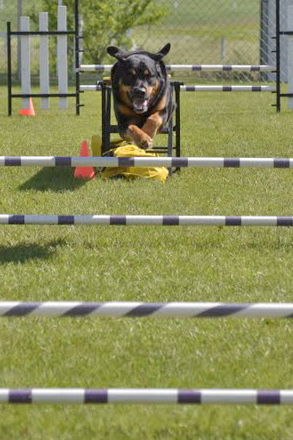
I love A-Frame photos, they always seem to highlight just how powerful a dog’s hind end is.
Advanced Gamble – Our first run of the day started with plenty of barking (my bad handling). We completed enough obstacles to earn 24 points (we only needed 16) however I stepped over the line in the gamble because I assumed we incurred a refusal. In the end it was a non-qualifying run but I wasn’t really expecting miracles – we got the one starters gamble leg we needed in 2007 before the Starters Games title requirements changed and I think it might have been a fluke.
Starters Jumpers (1)
This was a gong show. the course looked easy however the inclusion of a straight tunnel (twice!!!) meant Bear picked up a ton of speed and I could not get to my planned crosses soon enough. We earned 2 refusals and a knocked bar for our efforts – all 100% my fault.
Starters Standard (1)
This was the event I was hoping to qualify in – we only needed one leg to complete our title. Bear completely missed the weave poles and I had to call him back – he did them properly the second time and then drifted again on a rear cross…otherwise the run was perfect until he jumped over the down contact on the A frame (3rd to last obstacle). I was relatively happy with that run since he was quiet and mostly attentive. right after we went to the pee pit and he had a #2 so clearly the sniffing was a hint that he had to go to potty and I am fortunate that he did not go on course because that makes things difficult for everyone else for the rest of the day.
Starters Jumpers (2)
This courser was somewhat easier in that it was a bit slower however, I misjudged the placement of one of the jumps and Bear blew by it. Had I been paying attention, I would have seen that Bear’s jumping path after the tire would take him way out to never land, thanks to his super long stride. We recovered, finished the course and I even managed to call him off of a tunnel which is a big fat deal for a dog that LOOOVES tunnels.
Starters Standard (2)
This was the final run of the day. Bear did NOT want to return to his crate after the jumpers run – he was tired and hot (temps were around 30 degrees Celsius). I hoped he would just be able to keep it together long enough to finish the course. The course started of with the A frame which we completed successfully and things went reasonably well until we got to the weaves. we wasted valuable seconds finishing those but managed to do it and finish off quite nicely. It wasn’t a pretty run (see it below) but we QUALIFIED!
This was the 3rd and final leg required for Bear’s Agility Dog of Canada Title.
Bear and I with judge Brigitte Hunter and our pretty title ribbon.
Lessons Learned
Things I remembered:
I need to take Bear to potty about 2x more than I think I do!
Bear is REALLY fast – in some cases as fast as the Shelties and Border Collies out there
I am REALLY slow – at least compared to Bear
Bear works better when he’s quiet and when I am handling better.
Things I learned
We need to work on contact obstacles at a distance – we would likely have qualified if we were both more confident in that respect.
We need to work on rear crosses. By we, I mean me. In our jumpers runs I saw opportunities for rear crosses and chose front crosses instead because I am more comfortable with them but the reality is that in order to do a front cross I need to be AHEAD of Bear…fat chance!
We need to work on weave poles. Messing around with weaves cost us a lot of time (20 seconds in our last run!!) and now, in advance standard we need to make the weave entry on the first time or we cannot qualify. When you say that you would be willing to volunteer as course builder – that means you get assigned to building EVERY course that day.
Course building is actually not so bad, you actually work for about 15 minutes between courses and then can sit back and relax while teams are running.
Course building is also a great way to learn about how courses are built, what kinds of challenges judges like to (and are allowed to include in a certain course).
While I am busy at an Agility trial this weekend (and recovering from it), I figured I would give an update of the rally which took place here in Brandon last weekend.
To say the least, this trial was interesting.
This is the first time in a while that we’ve had a trial in Brandon where I was not judging and so it was almost relaxing to ‘only’ have to worry about being be trial secretary and running Bear.
For the past few summer and fall trials, we have opted to hold one day of the trial indoors an the second day outdoors. This set up tends to give competitors the best of both worlds and, in case of inclement weather, we are only forced to cope with one day outdoors.
Since the new year, Bear has been coming to work with me on a very regular basis. He does not get to play much since he can be cranky with other dogs but when he does come he gets quiet time in the morning, comes out at lunch while the others are eating and then more down time in the afternoon. Before other dog get here and during lunch I try to do 5-10 minutes of work at a time. For the past few months I have been focusing on:
A moving down on a verbal cue only
Straight sits when we are facing walls
180 pivots left with only one cue.
Ignoring the food bowls
Working on both sides
These may seem relatively minor – straight sits are only a 1-2 point deduction – but in the C stream, we need a score of 190 or higher to qualify and those points seem to disappear rapidly.
Since we were at home, I entered quite a few events every event we could figuring that if he started to peter out or lose focus we would either do FEO runs and/or just stop all together. I never seem to be able to predict how Bear will behave at a trial so I always have a ‘worst case scenario plan’.
Saturday, June 16, 2012
AdvancedC (1) – This was the first run of the day and it included the dreaded food bowls. Fortunately enough Bear only paused momentarily to sniff them on the first pass and I was able to recover him with a quick “hurry”. The rest of the run was flawless. Both the sniff and the extra cue cost me 2 points for a total deduction of 4 points and a score of 196. This was our 3rd leg towards the CARO Rally Bronze title.
Advanced C (2) – This run did not include food bowls! *Big Sigh* The course went very smoothly until bear’s nose got the better of him at one of the pivots. I used an extra command to get him to sit (2pts) and then we continued on flawlessly. We finished with a score of 198! Unfortunately we already have the maximum amount of Advanced legs needed for the CARO Bronze title so this leg will go towards our CARO Rally Silver title.
Excellent C – This course was a short one but had the wonderful challenge of having to run by the jump within a foot of the jump standard to be exact. For dogs that have been trained in agility and dogs that have done a lot of jump work, jumping is reinforcing and a jump within a foot is the very picture of temptation. We made it past the jump without taking it but we did lose a few points when Bear popped out of the weave poles (-4), when he moved slightly out of position during the back up 3 steps(-2) and when I gave him a second “down” cue during the moving down(-2). I did not need to give that extra cue and should have kept my mouth shut we did manage to qualify however with a score of 192, earning our fourth Bronze leg.
Excellent Team – We got to do this run with a team that finished their advanced team title just an hour before I don’t think the dogs had worked together before and we were in slightly cramped quarters in the small rung but both dogs worked very nicely. We finished with a score of 197 earning our second Excellent Team leg.
Versatility C (1) – This was our very first time competing in the Versatility C class. Bear was on the ball until the weave through legs when we got confused. I’m not sure what happened but as I told him to “go through” he for some reason came around in front of me, went through my legs and then stood behind me with a strange look on his face. Figuring we had botched that side change up and knowing we could not retry stations in the C stream I continued on. The rest of the run was perfect with the exception of Bear getting a bit ahead of me during the slow ace at the end of the course. We did not qualify in this run but if we had managed to perform the through legs station correctly, we would have had a score of 198. All things considered I was pleased. we were both really confused but able to pull ourselves together and keep going.
Versatility C (2) – During this run, I was more consistent with my cues and we did the side changes perfectly. We did however lose 3 points for a crooked sit during a pivot – ironically this was a pivot out in the wide open, not one that was directly facing the wall. We finished with a score of 197 and earned our fifth and FINAL leg towards the CARO Rally Bronze title!
What a wonderful way to end the day!
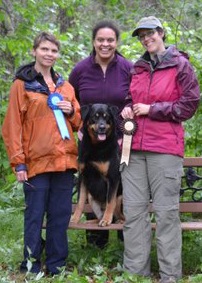
Bear and I with Judge Patty Rollheiser (L) and Marne Birch (R) after earning our CRB title and High Scoring Senior Dog in Trial.
Sunday, June 17, 2012
On Sunday, the trial moved outdoors. Having had a wonderful day on Saturday, I was not worried about Bear’s performance outdoors. We practiced a total of 2 times in that ring and Bear had been hit or miss – Birds, Squirrels and smells were distracting – I did not have high expectations.
Excellent C – Our First run of the day was quite nice until Bear took the tunnel instead of the jump right beside it. In hindsight I did tell him “OUT jump” and I think the tunnel looked more inviting than the broad jump even though it was out of his way. This disqualified us instantly but we kept going and, had he taken the tunnel, we would have finished with a score of 195 – Bummer!
Excellent Team – We chose to go second in this run and started of nicely until bear got so distracted sniffing that he actually walked the broad jump – Instant NQ which was too bad because our team partners performed well.
Excellent Team – This time we chose to go first, in the case that writing a whole minute was just too much for Bear. Apparently it wasn’t our day because we pointed out with more than 20 points worth of deductions – most of them ours.
At this point, I pulled Bear from the rest of the day’s runs. It was apparent that he was not going to work or rather that the rain, and smells of the bush were too much for him.
On a positive note he did perform a wonderful moving down – outside – in the WET(!!!) grass.
Weekend Lessons
The lessons I took from last weekend are that:
A little bit of work goes a long way: No NQ’s on moving downs or food bowls and very few crooked sits.
The largest factor in Bear’s performance is stress/distraction, not time or number of runs. In our home training environment he qualified in 5 out of 6 runs. I did not have a lot of time to do settle work and he rested both in the car and indoors in the building.
I need to do more practicing outdoors if I want to see improved scores out of doors.
We are entered in a local agility trial this weekend – the first one since 2009!
We have returned to agility over the past few weeks and had the opportunity to do a few full runs which oh-so-wonderfully highlight the holes in our training which are:
Weave poles: missing entries
Table: overshooting/using it as a launch pad (to nowhere!)
The good news is that if Bear misses the weave entry or the table, we can retry both obstacles without incurring faults and NQing, so long as we perform the obstacle correctly the second time.
The weave poles have been inconsistent in class but were fine yesterday so I am wondering if the fall in weave pole performance might have been related to the iliopsoas injury. I think I might get out the 2x2s and start a refresher over the summer.
The table was never an issue for us but we have only seen it once since returning to classes which means one day in – oh – 3 years. The club where we take classes seems to have limited equipment and the table can only be used in one class at a time. If it continues to be an issue, I may have to make one!
Aside from the obvious technical aspects of the obstacles, my challenges handling through the practice sequences in class with Bear have been:
Consistency of cues
Shutting my big mouth
Getting out of the way so Bear can do his job
The nerves of trial situations always make me flail my arms like a drowning chicken and use verbal cues I NEVER use in training. Remaining quiet, calm and graceful take every ounce of effort I have…because I am not any of those things naturally.
Whatever happens, I hope to convince someone to video our runs so that I can review them and learn from mistakes (or sucess!).
Speaking of video here’s one of a jumpers run in class from a few weeks ago…then I would say he would have been about 90% recovered from the injury but he’s a full-steam-ahead 100% now!
Way back in May, Renee and I attended a lecture delivered by Temple Grandin right here in Brandon Manitoba! The conference room at the Victoria Inn was packed with approximately 700 individuals from all walks of life. To say the crowd was diverse is an understatement. There were folks dressed up in their western best (including hat and belt buckle), there were folks in suits, folks from the hutterite colonies and folks of all ages including what appeared to be 3 generations of one family.
Since this lecture was sponsored by the Manitoba Pork Council and the Manitoba Beef Producers, it was geared towards the welfare of animals raised for food production (meat, milk, eggs etc.). That being said, a lot of what Temple Grandin had to say about farm animals is also applicable to companion animals.
The gentleman who introduced Temple Grandin (I don’t remember his name) spoke of animal welfare in terms of Brambell’s five freedoms, developed from a British report on livestock husbandry in 1965. These freedoms are:
Freedom from hunger or thirst
Freedom from discomfort
Freedom from pain, injury or disease
Freedom to express normal behavior
Freedom from fear and distress
One of they key concepts that kept resurfacing during the lecture was that reducing an animal’s stress can improve their lives in a multitude of ways. In the case of commercial livestock operations, lower stress means healthier animals which in turns means more profit. In the dog training world, I think folks are just beginning to fully understand stress in dogs and how it can affect their health, well being, behavior and performance. The following constitutes my notes from the lecture with my toughts written in bold italics.
Environmental Stress
Where cows live and the conditions under which they are raised can affect cattle behavior. Cattle that are used to humans, to cattle chutes (to collect cattle for transportation or medical procedures) and allowed to explore their environment are easier to handle and they have higher weight gains than those that are forced into new environments and new situations with new people. In fact, research has proven that when animals voluntarily cooperate during a procedure their bodies produce less cortisol (a stress hormone) than when they are forced into the procedure.
I see this every day at dog daycare and as a trainer who uses positive reinforcement to teach new behaviors, I understand and see how much more relaxed dogs are when they are used to volunteering behaviors to earn rewards compared to when they are used being forced to do something in order to avoid punishment.
Genetic Stress
Producers need to understand that when they over select for one trait (like faster growth) they may be loosing others (health bones that can support the weight of a heavy bird). She calls this bad becoming normal. Since sow stalls are a hot button topic she suggested that many of today’s sows would not be able to live in a group environment because farmers have been breeding pigs for lean mass, growth rate etc and they have no idea what temperaments they have been breeding because breeding sows are largely been isolated as a matter of course. Her suggestion is that in order to find an alternative to these stalls, part of the solution is going to involve including temperament in the traits that are selected for during the breeding process.
In the dog world the most obvious example of this is in purebred Bulldogs, many of which cannot reproduce, deliver puppies or breathe naturally. In the UK rules have been introduced to make breeders (at least those involved in dog shows) more accountable for the health of their breed but in other countries like Canada, breed health is largely left to individual breeders. Some are breeding for conformation or looks that win dog shows. Some are breeding for temperament and working ability (police dogs, guide dogs and some sport dog breeders) and an even smaller fraction of breeders are trying to maintain the entire package of a physically sound dog, with a wonderful temperament that will live a long, healthy life.In the designer dog world and backyards around the country, the exact same thing is going on only people are breeding for ‘small’ dogs regardless of health and temperament. I am not either for or against purebred dogs but I am certainly for a dog that can enjoy a walk with his owner, without collapsing because it can’t breathe, lunging at everything that walks by or dissolving into a puddle of stress – whatever the breed, or mix of breeds.
End of life Stress
Dr. Grandin also spoke of how animals that enter the plant quietly and calmly, are more likely to be effectively stunned prior to slaughter. During the question and answer session, one gentleman asked about how he could ensure humane euthanasia on the farm since processing plants no longer accept sick or dying animals – even if it is to dispose of them humanely. Dr. Grandin’s reply was that one of the things to keep in mind was the animal’s level of suffering either on the farm until it dies of illness injury or disease or en route to the plant because it was unfit for transport. She spoke of how (especially with companion animals) technology has come so far that now we are able to keep animals living longer but she states that sometimes a long life is not a better life. If I remember correctly, her exact words were “a dog with cancer does not know chemotherapy will make him better. He just knows he’s suffering.”
It had never occurred to me that farmers would struggle with ending the lives of sick and dying animals the way pet owners do. In many ways, I suppose it is worse – farmers struggle with the loss of an animal and the additional stress of the accompanying financial loss. As a business owner, of a relatively new business, I have first hand experience worrying about financial losses but, I never have to add the stress of euthanizing and animal to that equation and I can only imagine the loss of an animal and that is also costing you financially creates an extra helping of guilt.
Changing Behavior with regards to animal welfare
It would seem that animal welfare audits are becoming more common place in slaughterhouses. According to Grandin this is not because producers decided to raise their livestock to a certain standard or because buyers (large corporations like McDonalds) decided that they should only buy meat from animals that are ethically and sustainably raised. This change was largely the result of consumer demand for healthy food and ethically produced food. Consumers put pressure on large buyers, large buyers change their standards to appease consumers and slaughter/processing plants livestock transportation companies and individual producers are forced to follow suit if they want to stay in business.
When it comes to dogs, I think we face the particular challenge that companion animals are not regulated to the degree that ‘food’ animals are. You can trace the origin of your steak down to the cow however many dogs sold online, in newspapers and on websites are untraceable if the breeders are not using registered purebred stock. Further more, there is no guarantee that your dog will be healthy or even tempered just because you purchase from a registered breeder because there is no mechanism currently available to makeBreeders do health testing on their breeding stock and even if they could, the complexities of genetics are always expressed in different ways in any breeding. We all know how we are both similar and different from our siblings an the same goes for dogs. 9 out of 10 puppies may be mentally sound but one may suffer from crippling fear for it’s entire lifetime, regardless of the planning and care taken when choosing breeding stock.
The breeding of cats and dogs is an unregulated industry and there are no large buyers so it is left up to individual consumers to determine whether their pet is coming from a breeder or rescue that is truly concerned with providing animals with the best health and welfare possible.
The following Courses are nested which means that the course changes between courses or levels are minimal and the trial can move along quickly. This is especially important at large trials or when a person is running multiple classes . The following courses from a trial on April 15, 2012 are nested in the order they are listed.
If you would like to have your course featured as a course of the week, just email it to me (prairiedogdaycare@yahoo.ca) and I’ll happily give you credit and provide your personal or business contact info and link.
Today Bear seemed much improved. He is getting into the car by himself slowly, and he is walking upstairs on his own without having to put two hind feet on each step. He is also moving around a lot more when he has some time to stretch his legs at work. and, he is back to lifting a leg to pee in the yard and it seems like he’s using both legs equally for this purpose. These are all things he wasn’t doing at the beginning of the week. I have been continuing range of motion stretches after he’s been up and moving around a bit and he is significantly more stiff on the left side but his muscles seem more twitchy on the right. I’m certain this is a result of favoring one leg and over using the other do I have also been trying some light massage before the icing.
Day 10 – Monday
After a weekend of walking, tracking, stretching and alternating hot and cold packs, Bear appears to be feeling better. In fact, I know this because as I was reading in bed, I heard a growl downstairs the kind of growl that mean’s “it’s ON!” and that is usually followed by wild, puppy-like shenanigans. Sure enough the growl was followed by thump, thump, thump, up the stairs and thump thump thump down the hall then thump THUMP onto the bed!
And then back downstairs again to Sean who came upstairs and asked, “did you get the dog wound up?” in an accusatory voice (I gave strict instructions upon Sean’s return home that there was to be none of the typical play between of them.)
My answer was “No, but I think he’s feeling better”.
Day 11 – Tuesday
Warning! The following is not meant to be a substitute for veterinary care or work with a qualified Canine Rehab Therapist. If your dog is injured – SEE A PROFESSIONAL!
We started our rehab work today. Basically the injury is more or less healed and I am not seeing or hearing any indication of pain. Now the job is to keep Bear strong and flexible. Aside from stretching, our exercises will include:
Beg
Beg & Jump Up
Paws up (say your prayers)
Walking with a theraband around his one back leg for resistance.
Side steps (both ways)
Front paws on balance disc/exercise ball
Back Paws on balance disc/exercise ball
This is gonna be fun!
Day 12-17
This week was fairly boring, mostly kept up with our walking stretching and exercises as listed above. Bear seems way more comfortable but his stretching is limited and he is much worse on the left rear leg than the right.
We are staying away from rally and agility for now as I have a feeling that too much running and jumping on a leg with such restricted movement might cause some other injury.
Day 18
Today we (and by we I mean Bear) had a massage with Carolyn of Backstretch Equine & Canine Massage. Bear was the calmest he has ever been for Carolyn which says to me that the massage felt quite nice to him. Carolyn said he was actually in very good condition with the exception of the obvious stiffness and a few tender points along the front of his rear leg (In a human I think this would be in the quadriceps and calf area – not sure). Post massage, Bear seemed to be sore but if you have ever had a massage post-injury, you know that sometimes the day of the massage your muscles may be sore but there’s a lot of relief the day after.
By Monday Bear was moving very nicely and was much more flexible during stretches – clearly massage is helping and we told Carolyn we’d like to see her again soon.
Day 19-24
I have been gradually increasing activity – some fetch after tracking or after we do some walking/heeling. and Bear seems very comfortable. not 100% but his flexibility is getting better.
Day 25
Today we returned to Agility class which happens to be a fun run. The advice from the rehab therapist was to go slow but to increase the type of exercises we do gradually, pay close attention to Bear’s body and see what happens. My plan was to do a good warm up, some stretching and then try a course to see how things went. The courses set were jumpers courses which was perfect. Jumpers courses do not include contact obstacles or weave poles. If Bear is ok after this course then we will try something more complex next week. If he seems sore, we’ll dial it back.
We did our warm up stretches and two runs (at a very short jump height of 10”) followed by some more stretches. Bear seemed to handle it well. I have a recording of our second run and Bear’s gait seems off but to be honest, I rarely get to see him running from a spectators viewpoint so I have nothing to compare it to. Later in the evening we did some more stretches and all seemed well.
Day 26
Today we did some heeling and some stretching which all went well. Bear also has been wrestling for short periods with his friend Bella who is here for a weekend sleepover.
From here on in…
I think we will be ok if I stick with the rehab exercises and with the stretching. I find that our stretching routine is something that Bear just lays down and enjoys now – before he would be cooperative but I would have said he was only tolerating it. I also need to remember good warm up and cool down routines to keep him limber.
To be honest, I don’t see anyone around us do stretching, warm up and cool downs with your dogs – no wonder it was never part of my agility routine. I see people do “warm ups” but they seem to be more “focus” warm ups than body warm ups. I also see dogs in very expensive dog gear including coats to keep them warm and therapeutic coats – I don’t discount the value in keeping dogs warm between runs with regular or therapeutic coats but I doubt they actually replace a proper warm up and stretching.
Is Bear tracking or faking it? Right now only he really knows!
Spring sprung many weeks ago here in Manitoba and it’s high time to start thinking about preparing for the fall tracking tests.
I pulled out of the last tracking test we entered because I wasn’t certain we would pass. Actually I wasn’t certain of anything – I followed “the plan” but things did not seem to be coming together for us and, being new to the sport, I am still not sure what to do about it.
What I do know is how to teach many other behaviors and I figure that if I can teach a dog to skateboard, sit pretty and hide his eyes in ‘shame’ – surely I can use the knowledge gained through that experience to teach tracking which is far, far more natural to Bear than any trick he knows.
Typically, when things deteriorate in other training venues, I sit down and think of reasons why training has not been effective. This is my list for why our tracking training may not have resulted in the performance I wanted.
The rewards were not all that fabulous to Bear.
I was convinced Bear was tracking and he wasn’t.
Bear was tracking and I assumed he was goofing off and ‘corrected’ him but holding on tight to the line and not allowing him to do the job I wanted him to.
Food was faded before he understood the behavior.
Food drops were used for so long that he assumed that if he didn’t find food within a certain time period or distance, the game was over.
The food drops on the track were very rewarding but the final food drop/reward was not because either a) he was full or b) it was the same as he got on the track and not something ‘special’ enough.
We progressed through the plan too fast – That is to say we moved on to more difficult work before Bear fully understood the foundation work.
So, either the reward for tracking was not ‘awesome’ enough, I need better skills at observing tracking behavior versus other sniffing behavior or I moved too far too fast.
Now what?
I was hoping to either host or attend a tracking seminar this spring but that does not look like it will come to pass, unless I am able to drive to Saskatchewan or Alberta, and that looks unlikely with my summer schedule.
In the absence of that I am going to have to try an problem solve myself and try to get out to track with some more experienced folks in Winnipeg who might be better able to help me figure things out. At home my plan is to:
Start the training plans from scratch.
Keep records as I did last year but remember to include notes on Bear’s behavior as it applies to wind direction.
Resist temptation to proceed with the plan (increase age, distance etc.) unless I am 100% satisfied with the previous day’s performance.
Use flags for a long time so I know where the track is and can (hopefully) start learning to distinguish better between tracking behaviour and non-tracking behaviour.
Make the reward for the article on the track huge. I think Bear is a highly food motivated dog so my plan is to use some ‘exotic’ foods and to make sure they are only ever used for tracking, much like I have used tuna loaf exclusively for rally trials. I think I’ll use tuna (out of the can), sardines, liver loaf.
I spent this weekend at an agility handling clinic. I had paid for a working spot however due to Bear’s recent injury we gave our spot up and attended as an auditor. The purpose of the clinic was to work on the Greg Derrett handling system buy working on a number of sequences.
Saturday was the novice dog day ( the one we were supposed to run in). Sunday was for advanced dogs. Both days began with some review of the Greg Derrett video and then proceeded with a series of sequences that provided an opportunity to work on the concepts discussed.
In many ways, not having to worry about a dog was nice, it meant I could really spend 100% of the time watching dogs and handlers. The downside is that I have no idea how Bear would work through sequences so I may start working sequences and then get stuck if he does something no other dog at the clinic did. That being said, a few common things emerged over the weekend that I plan on working on with Bear.
Start Line Stays.I’ll need to write a a whole separate blog post about them. Suffice it to say that the challenge with the start line stay is the dog understanding his job and being confident enough to stay while the handler walks away.
Acceleration/Deceleration to signify change of direction. This is new to me but it makes sense as a great way to indicate changes of direction to dogs. With a large dog that has a long stride, I’m going to need to make sure this is a concept he understands. I think he does, but I’m not sure.
Lead Out Pivots. This is a great way to gain ground. Most importantly though, I learned the position of the handler during the LOP is critical to communicating deceleration and a change of direction to the dog. With a large dog that moves quickly, communication is critical – I’m going to need this skill and I’m going to need a good lead out on various obstacles from various distances and not always in a perfectly straight line.
Tunnel Calls– Again this is a way to communicate turns out of tunnels with any dog but fast moving ones in particular. A call in the tunnel with let the dog know where the handler is so that he can collect himself and exit on the correct side.
Independent 180 and 270 turns.when dogs that do not need handlers to babysit these obstacles handlers have less running to do. I’m all about running less.
Rear Crosses.I can’t say we’ve ever worked on these. The good thing about this is that we don’t have any bad habits to fix. The bad part is, we’re starting from scratch.
Goal Setting. We also spent a few minutes discussing training plans and goals and the importance of not confusing goals (staying connected with your dog throughout the course) with outcomes (earning a title). This is a really important distinction and something that I understand, likely because I have experience teaching and planning how to teach for dog training classes. The challenge for novice handlers in any sport is being able to know what you are doing wrong, what you need to do to fix it and how you are going to go about doing it.
The fortunate thing about all of these items is that, with the exception of Goal Setting, they are about teaching and learning) communication skills, they can be done on the flat (without the jumps) or using jump standards with a bar on the ground between them.
I am really looking forward to Bear’s return to agility so we can work on some of these things!
Do you know what the heck an iliopsoas is? I didn’t until this week.
This past Saturday at Rally class, Bear didn’t seem quite right. His pivots weren’t as enthusiastic as usual and while he was excited to work he was slow and lagging behind a bit. This was uncharacteristic behavior for him. Wondering if he just needed a break, we stopped and did some of the tricks he likes to do like spin, turn , hide your eyes and sit pretty and even those did not perk him up. If I was a more traditional trainer I might have assumed he was “blowing me off” but knowing Bear, I knew something was wrong. We tried a jump (he loooooooves jumping) and on his way out he was not moving quickly and his gait was off. I decided to limit our participation for the rest of class to heeling and sits, which didn’t seem to cause any trouble.
Sigh.
He could barely climb into the car after class to get home and then he was equally slow climbing the 5 steps to the house. Once inside, he tried to get up onto his favorite couch spot but got half way, whimpered and then went to his kennel and lay down.
Crap.
Once I was able to coax him out of the kennel, I poked and prodded to see if I could feel and swelling, any heat, bleeding or any foreign objects.
Nothing.
Taking a wild guess, I applied some ice packs to his inner thighs, he lay there quietly and I took this as a sign that maybe the cold was providing some comfort. That night the stairs were a no go and, since I did not want to sleep on the couch, I carried Bear up – not as easy as I imagined.
Day 2 – Sunday
Sunday morning Bear managed to walk downstairs but he spent most of the morning on the floor or in his kennel which is highly unusual. When we are at home he is usually following me around, taking my spot on the sofa if I get up, waiting for me outside the bathroom door, trying to sneak into the kitchen if I’m in there making lunch, supervising when I load the dishwasher, etc.
Since he appeared to be in more pain than he day before, I gave him a buffered aspirin, one of the safer human anti-inflammatories for dogs. The only anti-inflammatory Bear has received in his life was given immediately after his neuter surgery so I went with a low dose for a dog his size and continued to ice the area that seemed sore.
I went online and consulted with Dr. Google, DVM. She said he likely had hip dysplasia, or tore his ACL or had a neurogical condition.
Wonderful.
Day 3 – Monday
Since I had myself convinced of the worst, I had to get in to see the vet, Dr. Radcliffe, so she could either to put my mind at rest or to confirm Dr. Google’s diagnosis. I called, and luckily she was in and had appointments available. She watched him moving then she poked, prodded and stretched Bear’s legs in every conceivable direction (at least to me) and he seemed ok. Then, she finally extended this leg ALL the way back and rotated it inwards. This elicited a squeal on both sides and she said she suspected it was a muscle injury. She consulted with her notes and decided it was likely iliopsoas injury. She did an infrared treatment and suggested rest, light exercise (walking), massage, stretches to maintain range of motion, icing and, perhaps later on, some more infrared treatments or even acupuncture. She also sent me a one page info sheet from a veterinary surgeon about this kind of injury.
According to my research, the iliopsoas is a hip flexor and is used during jumping, tight turns etc. to keep the dog stable.
Sigh. (Of relief)
My crude ‘artists rendering’ of where this pesky little muscle is – actually there are 2 of them – one on each side.
I am a little disappointed – we were just getting back into agility and had a seminar this weekend, we also were making plans to begin herding but alas, it looks like our plans will be postponed. Fortunately, having played nearly 15 years of rugby and run 2 half marathons, I understand the consequences of pushing through pain and with a 7 year old dog (or any dog) it’s just not worth it.
Day 4 – Tuesday
I contacted Bear’s Canine Massage Therapist (don’t laugh!) about the injury. She is planning on visiting soon (she lives about 2.5 hours away from us) but I wanted to let her know sooner would be better than later. She basically said that massage is good for keeping everything else in that area but that this was was a difficult muscle to reach. In my crude drawing it’s there and obvious but it is covered with lots of muscle. She suggested an appointment with someone who specializes in canine rehab might help best with the specific injury.
So after trading a few more phone calls with the vet clinic (I know their number by heart now – how bad is that) I learned that someone in Brandon, who I know, has completed her canine rehab course. I’m not telling you who yet because I’m sure once word is out, she will be flooded with calls and right now, she’s not officially taking clients.
Day 5 – Wednesday
When the Canine Rehab Therapist came to see Bear and we did more walking, trotting and she did some manipulation etc, she said she was certain he would recover quite well if I can stick with the program. According to her the program will consist of icing then ice followed by heat, stretches, and eventually rehab exercises. She said the thing Bear has going for him is that he allows touch and heat/ice packs and he is very responsive to training so teaching the rehab exercises will be easy. The program also entails keeping him from jumping until he is healed – jumping off things, onto things or doing other crazy jumping dog things – this is going to be the hard part. She’s going to put the plan on paper and until we get the plan we’re going to use our ice packs, our hot pads and maybe our tracking harness since walking (with his nose) is about the only activity he can do right now. Fortunately water is a tracker’s best friend and there is lots of rain in the forecast for this weekend!
I’ll follow up with an update at the end of the week – Our rehab plan should be interesting!



 Ayoka Bubar BA, CPDT-KA