The following courses are nested which means that the course changes between courses or levels are minimal and the trial or class can move along quickly. This is especially important at large trials or when a person is running multiple classes. The following team courses from a trial in June 2012 are nested in the order they are listed.
Post-Test Plans for Tracking
Unless you try to do something beyond what you have already mastered, you will never grow.
-Ralph Waldo Emmerson
Oh haven’t you heard? I’m so done with feeling bad about the tracking test.
While I am not over it, I am moving on, negative feelings are – to use a word – exhausting. Between teaching classes, taking agility classes and driving to Winnipeg for herding classes, I’m a busy lady and unfortunately, there’s no room (or time) left for these horrible feelings to overstay their welcome.
I have come to a few conclusions over the past few days:
- Corners are not the problem.
- The problem is distinguishing between ‘looking for corners’ and ‘looking at distractions’.
- Bear does not have the problem solving skills he needs to find a track after he’s lost it.
- I have not been handling Bear in such a way as to encourage him to look.
- I have not been communicating success in way Bear best understands.
My new approach is going to continue from where we were in our training – which was adding more corners and increasing age of the track with the following changes:
- I am going to take the food off the track.
- I am going to use articles in place of food.
- I am going to use my clicker to mark the discovery of every article and reward Bear immediately with a cookie party – therefore making the articles ‘gateways to food’.
So far in my tracking reading and online research, there is very little in the way of discussing the applications of using a clicker or marker in tracking. Where I have found a short discussion on this is when it comes to developing an article indication.
While, I am certain there are people out there with some strong feelings against clickers and tracking, clicker training is the method I have used to teach Bear the foundation behaviors for agility and rally obedience and I do believe tracking bears some similarities to these sports:
- Just like tracking, these sports involve complex behavior chains and independent behaviors.
- Just like tracking, no training equipment or food is allowed while you are working so dogs must learn to perform without the use of any training aid, be it an electronic collar, walking harness, head halter, bait bag or clicker.
The clicker is used to build competence and enthusiasm for specific behaviors and, once a Bear becomes competent and proficient I have gradually increased my expectations requiring more behavior or better performance between clicks and eventually, I have been able to eliminate the clicker all together.
I don’t think the clicker will interfere with what seems to be the method for teaching corners (sadly I don’t think there’s a magic method) which is apply line tension before corners, plant your feet while the dog looks and release tension when the dog commits to the track in a different direction. In fact I am hoping that using our preferred communication tool, the clicker, will make the goal of the game incredibly clear to Bear so that he learns the fastest way to the article (and the cookies) is to use his nose to find the things that smells of the tracklayer.
At least that’s what I hope. Fact is, I don’t have much to lose by trying, do I?
Insanity: doing the same thing over and over again and expecting different results.
-Albert Einstein
Notes: Tracking lecture by John (Jack) Wilhelm September 2, 2012
The following is my interpretation of some of the topics covered in a short (2.5hour) lecture delivered by John (Jack) Wilhelm after our tracking test last Sunday. I am posting them, like I have for other seminars in the past, because writing helps me process things. I’ll add my thoughts/comments at another time.
Training vs. Practice
When working with dogs, we need to remember to have an objective for each training session. The objective could be training (teaching) a certain skill or practicing (testing) a skill.
Praise & Corrections
- According to Jack correcting a dog by yanking on the line/harness is not something a person should ever do but there is a place for correction in tracking. The examples he gave were of a verbal correction “hey get back to work” from the end of the line or dropping the line, marching to the dog and getting in their face. He also mentioned that when dogs make the proper choice after correction – copious praise is due.
- On the subject of praise it is his opinion that praise is often offered when dogs are not performing the desired behavior and then it becomes meaningless to the dog.
- What is not okay in tracking is to remove the dog from the track if they are acting up. If the dog is not into it, this is when having an article on hand for the dog to discover is appropriate before ending the training session. The dog should always find something.
Training vs, Test Day
- Do in practice what you plan do to the day of the test.
- Do not change your handling on test day – this will only confuse your dog.
Corners & Cross tracks
- When working with dogs on corners and cross tracks, use back pressure to slow them down at the corner and praise/release line tension when dog locates and commits to corner/appropriate track.
- Many cross track problems are the result of training which has not challenged the dog. Examples of challenges include cross tracks at very tight angles, walking a cross track carrying weight, even laying the cross track by riding a bicycle.
- Below is one method suggested for starting to train cross tracks. Using the same field lay a track – do your work – and the next day, lay another track your track across it. You can increase difficulty by decreasing the hours between tracks.

Distractions
If dogs are distracted by something and recover, allow the dog to investigate distractions after track is done and harness is removed – ideally off leash. This allows the dog to ‘be a dog’ while maintaining a clear distinction between work and ‘free time’.
Test Preparation
- Practice plotting tracks using landmarks.
- Practice at different times of the day
- Practice in different ground cover.
- Practice with someone following you in rain gear or a hat/sunglasses.
- Practice driving to a test site and having the dog go to work right out of the car.
Line handling
When dog is off track and looking, stay in one place and let line out as they go farther, pull in as they come nearer. In a blind track, the handler does not know where the track is – having the dog circle the same path is ineffective because the track may be 30 feet behind you.
Common causes of team failure
- Guiding by the handler– all examples were of handlers guiding with the tracking line by pulling the dog to perform a circle or corner.
- Handler accidentally corrects the dog– usually when the tracking line gets tangled or the dog takes a hard fast turn and the handler is not ready. The dog is essentially corrected for following the track and may be less likely to seek it out after this.
- Handlers pull the dog off of track before they have officially started– When start lines are a distance from the road, the track layer will be walking through the exact same area you have. Handlers who punish dogs for sniffing before they get to the track may not be able to get past the start line because the dog is hesitant to continue tracking.
- Handlers expecting the picture perfect indication they see in practice – Some handlers wait for the “perfect” indication rather they have seen in practice when the dog has obviously found the article and indicated it in an other way. Waiting too long may encourage the dog to resume tracking and follow the tracklayer’s path off the track.
Dogs that appear to be on track, and working…but aren’t
Someone asked a question about what to do with a dog that appears to be on track but that overshoot corners consistently always moving in a straight line with the impression the dog would go straight forever.
This brought up a shot discussion about reinforcing the effort vs. reinforcing the behavior you want. Jack suggested that this dog had learned that ‘assuming’ the position meant he would be allowed to continue forward. The solution – lay known tracks and use back pressure to slow him at corners – only releasing pressure when he is on the track.
Recommended reading
One person asked if there were any books on tracking that he could recommend – he did not as he said he hadn’t really read much in the past few years.
Our First TD Test – About as good as it could be…without passing
Before the Test
We met at a Denny’s for the draw. In tracking there is an advantage to an earlier track – early tracks are often aged less and are likely to have more dew remaining on the vegetation. Dew is good because moisture enhances scent.
Before the draw I got to meet a Facebook friend in person! Kristine travelled all the way from Calgary for the test.
I don’t know what I expected for the draw but the test organizers had four lovely mugs lined up, filled with dog cookies and wrapped in cellophane. We each chose a mug and on the bottom of the mug was the number corresponding to the track number we would be assigned. We drew 3rd track.

The Test
I got Bear out of the car, let him pee and then we had a few minutes to wait until the track was old enough. we walked the short distance to the scent pad, and I put Bear’s harness on backwards. Once I got it on properly, I showed him the scent pad and told him to find it.
I brought him back to the track once before the 2nd set of flags and we were off. Before we hit the second leg, Bear squatted to poop. I looked back the judge and tracklayer were standing watching but no whistle so once Bear was finished – we continued.
After the car, we drove en masse to the test site at Beaudry Provincial Park. The terrain is almost exactly the same as what we have here in Shilo. Natural prairie grass about knee high. We got to watch the first track, which I was looking forward to since I’ve never seen a test. Luckily enough the team was comprised of a novice dog but a an experienced handler. From far, it was really neat to watch. It was obvious to me when the dog was on and off the track. there was only one little “discussion” along the way where the dog was certain the track ran along a ditch and the handler was not so certain. Eventually the dog made her point clear and the handler followed. They found the article and finished the track in what seemed like less than 15. It was very educational – training alone means I never get to watch a team work from far.
After track #1, I had to return to our original meeting point in the park because they had to lay my track and I would be able to see the tracklayer at work from track #2. The good news is that meant we would have a relatively fresh track. The bad news is that we would not be able to watch Kristine and her Rottie Teah and I would be alone in my car with my nervousness and anxiety. During our wait, I took bear for a walk, a pee, made sure he did not have to poop, gave him a drink of water and then cocooned myself in the car, checked up on Facebook and blogs I subscribe to distract myself.
About a half hour after they left me, someone came back to take me to our track.
The Track
I took bear out of the car and, since we had some time to wait before the track was sufficiently aged, I took Bear out for another pee and organised my tracking line and harness. It was fairly windy (I would guess 25-30km/h) and our first leg was into the wind. I got Bear inbto his harness backwards, then readjusted it, showed him the scent pad and told him to “find it”.
On the first leg we had some difficulty and I brought him back to the track once before we hit our 30m marker flags. About 60 feet into the track, Bear crouched down for a poop. I stood, and looked back embarrassingly at the judge – expecting a whistle. Nothing came, so we continued. Before the test, I decided to go wherever Bear lead me. and about 80 feet in he circled a bit and then turned right…we continued on without a whistle so I assumed we made the first corner.
On the second leg, we progressed through some vehicle tracks and what looked like a place where deer had lain for a time as we moved forward, I saw the start flags for the final flag ahead and figured our corner was coming. Turning to the right would take us back to the road so I assumed at some point, we were going right.
Bear did turn right onto what I assumed was the third leg and then we had some more difficulty working into the wind and through some sort of animal droppings (goose, I think). Bear did a lot of stopping, starting, crossing back and forth, chewing (on lord knows what!?). We went ahead for quite sometime like this – it felt like an eternity. I tried using our find it key, I tried holding my ground and waiting for him to commit but he kept circling and coming back to look at me as if to say “what the heck is going on here?”. he also stopped to listen to train whistles and watch folks pass by on the road. It had been at least 10 minutes and he was starting to huff and puff so I just decided to let him go and see what happened. he found some sort of trail, urine marking a few spots along the way and about 60 feet later, we heard the whistle – It was over. I was relieved and disappointed.

Our very kind track layer Val, helped us find the article, even tough I wanted to race back to the car and cry. She also commiserated – her dog did not pass the TDX test on Saturday – she knew how it felt. I think if she had not been there, I would have packed things up and headed home.
The last and final track was right after ours and, after blowing my nose and wiping my eyes, I stayed to watch. The team was whistled off about as far into their track as we were.
At this point everyone headed back to ‘base camp’ for ribbons the judges comments and lunch. Of the four teams in the TD test, two were successful – the first team and Kristine with Teah!
To help myself not be overly disappointed, I have decided to summarize the day:
The Bad
- We did not pass.
- One person said she saw bear indicate the 4th leg and that I interfered with his work.
- Once we lost the third leg, bikers passing by, trains and just about everything became a distraction. in the past, only prairie dogs have been a distraction for Bear.
The good
- I got to meet a Facebook friend , her husband and her very sweet dog in person.
- We got through 2 corners when I was aiming for one.
- The first 3 legs were through some vehicle tracks and what looked like deer beds – these have been difficult for us.
- This is the first time Bear has followed a track laid by someone else since the seminar we went to in 2010.
- This was our first blind track ever.
- The judge said I had very good line handling skills – moving when Bear was on track, planting when he was off track.
- As expected, lunch was delicious and folks were very kind.
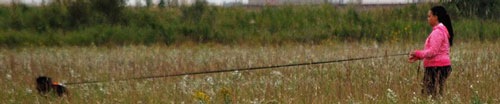
- One of the host club members took some beautiful photos. I like the one below a lot. Originals are viewable here.
What I learned
- A dog is not whistled off for eliminating on track.
- I should give some thought to giving Bear more space when we work.
- I was the only person training on my own.
- It’s easier to spot a working vs. non working dog from far especially when that dog has a tail!
Next Steps
I am going to need to think about what to do next. There is another tracking test in Regina in about 4 weeks and then that’s about it until next year.
Right now I am feeling more discouraged than disappointed. Training on my own has it’s advantages but the biggest disadvantage is that there is no one to reassure me that I am on the right path, and that in time things will be fine, that my dog has talent but just needs more training…

 Ayoka Bubar BA, CPDT-KA