Course Details
Level: Versatility (CARO)
Space Required: 30’x70′
Designer: Ayoka Bubar
Download this Course: CARO 30′x 70′ Course – Versatility (T12-051)
Course Details
Level: Versatility (CARO)
Space Required: 30’x70′
Designer: Ayoka Bubar
Download this Course: CARO 30′x 70′ Course – Versatility (T12-051)
 Course Details
Level: Excellent (CARO)
Space Required: 30’x70′
Designer: Ayoka Bubar
Download this Course: CARO 30′x 70′ Course – Excellent (T12-051)
 Course Details
Level: Advanced (CARO)
Space Required: 30’x70′
Designer: Ayoka Bubar
Comments: This is the first course I have seen, designed by myself or someone else, that has 4 passes through the offset figure eight. As of now (April 2013) this is entirely legal. The rules state that there must be a minimum of three pass through the center. Be warned! When you are practicing with food bowls make sure you practice going around 3 and 4 times.
Download this Course: CARO 30′x 70′ Course – Advanced (T12-51)
If you would like to have your course featured as a course of the week, just email it to me (prairiedogdaycare@yahoo.ca) and I’ll happily give you credit and provide your personal or business contact info and link.
I was supposed to be at agility trial in Thunder Bay this weekend…but low entries led to a trial cancellation. While disappointing and distressing I was *gasp* left with a free weekend. This gave me the opportunity to get one more herding class in before the herding clinic on the 19th.
I spent most of the class trying to figure out where I should be in relation to the sheep and when I should leave Bear to work. Apparently I have been in the way and to be honest, it always often feels that way. As usual, our second run was better than the first, likely because Bear is tired.
Today, however, with some great guidance, I got a few minutes of some nice calm work from Bear . Calm for him, that is. Now the challenge is for me to do what I need to do to keep it that way. Aside from calmness being easier on the sheep (and me) it will also the difference between a higher score and a lower score in a trial.
Today’s experience reminds me a lot of when I learned to drive a standard car. I knew what I should be doing, I knew how it should be done, I could get the car in gear occasionally but I lacked the timing and coordination to pull it off consistently until I had practiced (and stalled out) many times.
Unfortunately, the real problem with herding is not getting the mechanical timing right but coordinating the movements of living, breathing things with tiny brains – some of whom would rather be in another pasture, one of whom thinks wool tastes awesome!
 Course Detail
Level: Novice (CARO)
Space Required: 30’x70′
Designer: Ayoka Bubar
Download this Course: CARO 30′x 70′ Course – Novice T12-051

I have posted very little in the past few months.
My training with Bear has been neglected due to work related and personal things. we’ve been doing a bit of trick stuff here and there at work, but nothing even remotely structured. Now that spring is here and our first trial of the season in a few months, I have trying to plan carefully.
You see, I have this problem of entering a kajillion trials and tests in the spring and early summer and then hating myself by the end of September.
The scenario goes like this: I have a fabulous weekend out at a trial and then one week later things at home and fall behind: Laundry piles threaten to take over the bedroom, dish piles threaten to take over the kitchen, I eat out more than I should (which begs the question – how did those dish piles get there). In addition to the housework avalanche, getting up at 5:30am becomes more difficult than it already is and I spend many drives home from work in tears – because I am tired and over stretched – and I have only myself to blame!
Not. This. Year.
This means that I need to make sure I don’t do something stupid like book 8 weekends of events in a row. I also need to plan better for my precious weekday evenings. My goal is to plan to be home at least two weekends a month – every other weekend if I can – and so far, I have been plugging events into my google calendar keeping this in mind.
With Sean out of commission for 4 out of the past 6 months, most of the cooking/cleaning and laundry has fallen to me and I have learned that preparation goes a long way towards reducing my weekday stress. I spend a few hours on the weekend cooking lunches for the rest of the week and wash, dry and fold laundry all in one go pass the vacuum around the house and things don;t seem to get too far out of control. Miraculously, in the past few months this has become habit and I have free time on weekday evenings that I have not has since I opened Prairie Dog Daycare.
Am I the only one that drives myself insane doing something I love? Is there anyone in the world who can do it all…or do these people just exist in my head?
Hopefully all this planning will reduce the fall insanity a teeny tiny bit. if not, you knowhow they say, “admitting you have a problem is the first step”? I figure I can always try for the second step next year if things go horribly wrong in a few months…right? RIGHT!?!?!
Yesterday, since I had to drive in to Winnipeg to pick up dog food for work, I decided to bring Bear with me and go herding for the first time this year. We have not been out since our first trial in September but we are attending a clinic next month so I figured it could not hurt to get Bear out to see sheep – especially if it might prevent a meltdown in a few weeks.
I still have a lot of things as a handler to figure out including, staying out of Bear’s way when he’s doing what he should, walking in a straight line and staying on my feet!
As usual, Bear was his whiny, groan-y bark-y self (boy can a bark echo in an indoor arena!) but I was nicely surprised by two things.
First he was able to work with one of the resident border collies in the ring. The dog was occasionally ‘helping’ because in his eyes, I’m sure it was clear we had no clue what was going on. Typically bad things happen when Bear gets this close to a dog while he is so amped up. Yesterday, he looked at the dog – and if dogs could shrug, that’s what he did then he continued working the sheep. It may be because the dog does not even seem to register that Bear exists or maybe he’s just one of those dogs that never sends one confrontational ‘vibe’ to other dogs. Bear is the king of picking up on such things and dealing with them in an equally confrontational way. I don’t think he would be ok working with just any dog but this one, named Pistol, is now in the ‘tolerable dog’ category.
The second thing that surprised me was that Bear was able to work close to the sheep without having to use his mouth (for biting). There were a few times he would use his shoulder to move a sheep or a nose poke – but very little nipping and certainly no grabbing and holding. If we can keep this up and build on it then maybe, just maybe, there’s hope that I can teach him to drive sheep away from me which is something we’d have to do at the next level – if we ever get there!
We’ve got some excellent opportunities coming up this year in herding that include two clinics and a trial this spring and two trial weekends in the fall. For the spring trial my goal is to finish our Herding Started Title, we need one more leg. I think we will also give the Stock Dog trials a try. I’ve had to check out the rulebook because I don’t think I saw any Stock Dog runs last year and they look really fun. The Stock Dog classes are designed to simulate common farm chores. Dogs are moving stock over larger spaces than the arena trials and the obstacles are actually farm fields, pens, stalls and trailers, not simple 4×8 panels. It sounds interesting but not like something we would have been able to accomplish without any previous trial experience – I am looking forward to the extra challenge!
Since I spoke about running contacts in my 2012 wrap-up post, I thought I would take some time to share what we did in more detail.
I had been toying with teaching a modified four on the floor before our training was interrupted in 2009. What I had been trying to work towards was a down on the end of all contacts with the front feet off the contact and the rear feet on. Since our return last year, I decided that, given Bear’s age and my concern over his structure, I would try to teach a running contact. The worst thing that could happen was that we would d be stuck with the contact performances which was non-existent.
The method we used
If you can be certain of anything, it’s that if a particular technique is useful in competition, has merits, 5 different top level competitors will come out with 5 different methods for training it – and most of them will put this into a DVD, book or seminar.
Regardless of whose method one uses, the end result is that you have a dog that will:
Once I decided this was something I wanted to do, I did some Googling of “running contacts” among the results was a free explanation with videos and answers to questions from Silvia Trkman.
I will not get into the nitty gritty of the method, you can see it for yourself on her website. The basics of this method are teaching your dog, from the beginning that the two things that are rewarded on the a frame re 1.)speed and 2.) placing feet in the contact zone.
Bear and I went to a friends house to practice. I used a clicker to mark speed and foot placement and used a tennis ball thrown ahead as reward. It was if the light bulb really turned on for him and in about 3 sessions I had him racing over and coming all the way down. In 4 sessions, I was able to add a bit of distance and I now had a relatively consistent behavior to reward consistently in class.
Consistent rewarding in class has lead to a consistent performance of the a frame in a trial setting. I can only think of one missed contact in the last 3 trials
Advantages
As far as I can tell there is only one main advantage for most teams when training this method and it is speed. In super high level competition, a 10th of a second can mean the difference between 1st and 4th place.
Speed is rarely an issue for us because we always finish with time to spare unless we have to redo weaves – another story for another day.
Aside from speed there are two advantages for us:
Pitfalls & Criticism
The following pitfalls. criticisms and challenges come from both the internet and my own experience.
Why I think it worked for us.
I think there are a few reasons why this performance worked for us and I think that if your circumstances are different then it might not be the best choice for you.
Now that things are slowing down (relatively) for the winter I’m taking some time to consider what I would like to work on this year. I had look at my 2011/2012 goals and, while we worked little bit on all of them, the only ones we achieved was fixing the back up 3 steps for rally and getting started with Nose Work. Two is better than none right?
RIGHT!?!?!?
What have discovered is that it’s really hard to stay motivated to do something when that something has no real application in our competition lives or our daily lives. I have given up on the long stand/down – we aren’t likely to ever compete in any event that requires either exercise. Same goes for retrieving.
We are at a point in our competition/trialing/testing career that there are more things we could do than I have time or money for. Planning ahead will allow me to invest my training time and money on things that:
To this end, here is a list of things I’d like to try accomplish in 2013.
Agility
Health & Fitness
Tracking
Lifestyle/Home
Now that we are officially into the year 2013, I have been thinking about what a huge adventure the year 2012 was for Bear and I. We tried some new things, we succeeded at some things, we failed at others. I smiled a lot, I laughed a lot, I cried a little. Below are some of the great adventures we had this year.
1. Bear became a senior: Bear turned 8 (ish) at the end of December so 2012 was his first year as a senior. Aside from some lymph node swelling (NOT Cancer thank god, just a viral infection, we figure) he has been happy, healthy and fit as a fiddle. That doesn’t stop me from worrying about every little thing or dishing out all the prophylactic supplements that I can.
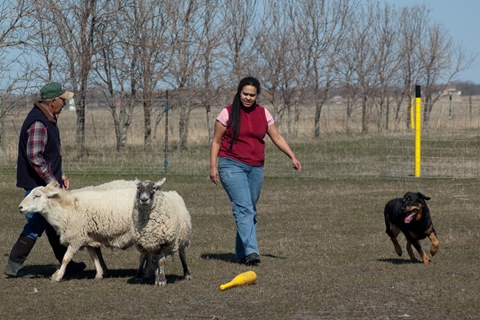
2. We met sheep: Meeting sheep was fantastic – the fact that Bear did not kill a sheep was even more so! Bear’s Herding Instinct Test was probably one of the best ‘dog’ experiences of the year.
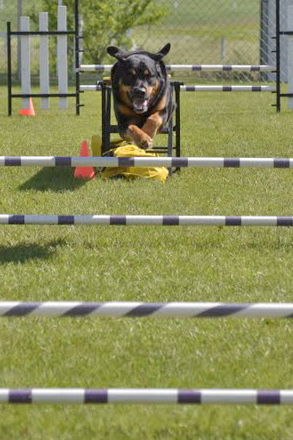
3. We went back to Agility: Finally, business at the daycare is steady enough and I have enough of a routine that I could make time to go back to agility. We are behind many dogs Bear’s age but we are still having a great time.
4. We entered our first Tracking Dog test: This was not a great time in the conventional sense but I stuck my neck out there, it was a learning experience and I’ll be damned if we go back and fail (as miserably) next year. 
5. Bear recovered from an iliopsoas injury: Not sure what started it but we managed to recover nicely with the help of a great vet, a great canine rehab therapist and a great canine massage therapist.
6. I attended my first online training class: The challenge of teaching classes and owning a dog daycare is finding time to train and someone to train under. The online Scent Work class gave us a great opportunity to work on our own at something completely new!
7. I judged at my first out-of-town Rally Trials: I had the wonderful opportunity to judge 3 times in Regina, SK. and had the opportunity to judge some wonderful dog & Handler Teams.
8. I made the switch to Raw feeding: After much consideration and a period of feeding both raw and kibble, I made the plunge. In hindsight, it’s not as big a deal as some make it out to be and I am happy I have made the switch.
9. I retrained the A frame contact for agility: I used Sylvia Trkman’s running contact method and have been thrilled with results. Since we made the switch we have missed a total on one contact in the trial setting.

10. I developed curriculum for 4 new classes at Two Brown Dogs:
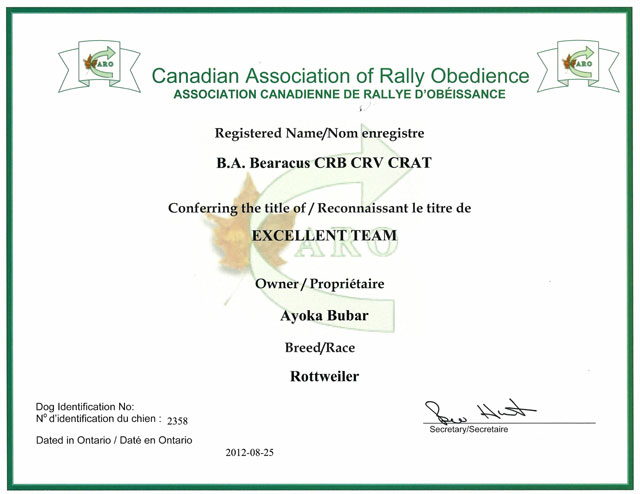
11. Bear and I earned 8 New Titles:
12. I accumulated 37 Continuing Education Credits towards my CCPDT recertification: In a little over a year, I have actually completed the number of hours required to recertify in December 2014. I won’t bore you with the complete listing but you can see some of the seminars I attended here.

 Ayoka Bubar BA, CPDT-KA